Designing Synapse: the learning platform behind an accredited UX diploma

Designing Synapse: the learning platform behind an accredited UX diploma

Information Architecture
Design Systems
User Research
LMS Product Design

Information Architecture
Design Systems
User Research
LMS Product Design

Context

BrainStation scaled from one 10-week Toronto cohort to an accredited 400 hour diploma program across three countries and five jurisdictions. That growth created a product problem: one curriculum feeding dozens of concurrent cohorts, serving instructors and students with conflicting needs, under jurisdiction-specific compliance. Synapse and Cortex were the systems I helped design to solve it.

BrainStation launched its UX Design program as a single
10-week bootcamp in Toronto. As demand grew, complexity expanded with it. New cities, formats, and requirements followed. The challenge was no longer teaching. It was scaling a consistent student experience across an increasingly complex operating model.

The program needed more than experienced and qualified instructors. It needed infrastructure.

Teaching one cohort well is a craft problem. Scaling dozens concurrently across time zones, formats, and compliance frameworks is a systems problem. Without standardization, quality would drift. Without systems, scale would fail. The core tension: scale operationally while maintaining a consistent, high-quality learning experience.

BrainStation launched its inaugural User Experience Design program as a 10-week, intensive bootcamp in Toronto. Demand accelerated quickly, expanding into new cities, new delivery formats, and new regulatory environments.

What began as a single-cohort teaching model evolved into a distributed system: multiple campuses, part-time and full-time formats, and jurisdiction-specific accreditation requirements. The challenge was no longer instructional quality alone, but how to scale it without degradation. The program needed more than instructors. It needed infrastructure.

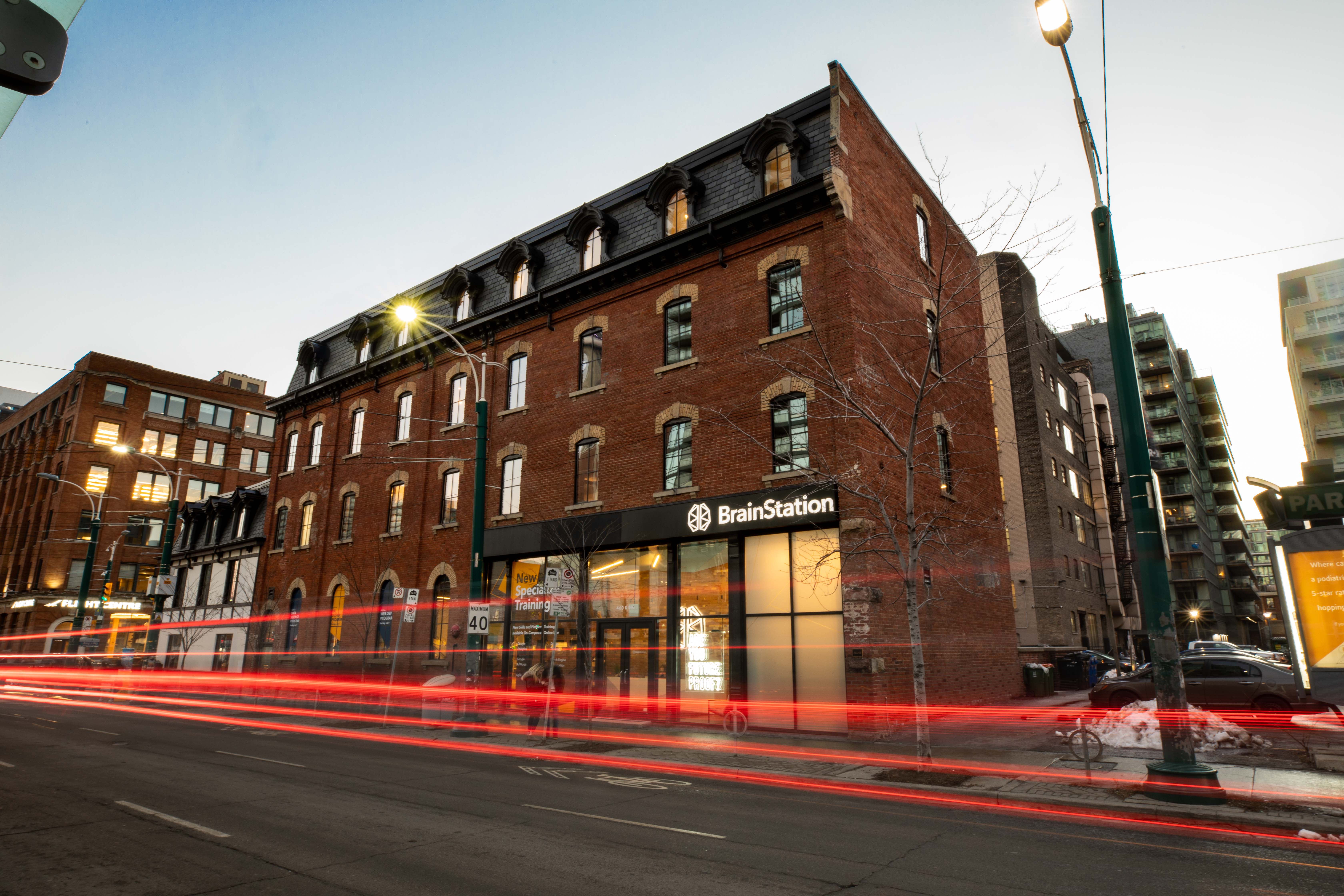
BrainStation Toronto campus, a renovated heritage building that housed the program’s earliest cohorts.

BrainStation Toronto campus, a renovated heritage building that housed the program’s earliest cohorts.

BrainStation Toronto campus, a renovated heritage building and the program’s first home.

Scaling Design Education as a Systems Problem

The program operated through four interconnected systems that together produced consistent delivery at scale. I supported all four as design lead, with my direct contribution strongest in the Synapse platform and the design system the team built across the program.

The system around Synapse

The program ran on four interconnected systems: curriculum, educators, operations, and the platform that connected them to students. I supported all four as design lead; my deepest contribution was Synapse itself, and the design system that spanned the entire program.

The program ran on four interconnected systems: curriculum, educators, operations, and the platform that connected them to students. I supported all four as design lead; my deepest contribution was Synapse itself, and the design system that spanned the entire program.

Curriculum, educators, and a custom-built learning platform delivered the program; operational governance held it together across campuses, formats, and jurisdictions. The two systems I helped design, Synapse and Cortex, sit inside this map.

BrainStation Toronto campus, a renovated heritage building and the program’s first home.

01

Curriculum System

Modular, versioned content architecture. Reusable assets, materials, and components that propagate updates across cohorts without fragmentation.

02

Educator System

Distributed team of 12 educators across North America and the UK, with shared standards for delivery and evaluation.

03

Synapse LMS

Custom-built platform centralizing delivery across instructor, student, and admin surfaces for every campus and program.

04

Operational System

Workflows and governance, run through Cortex, our custom CMS, coordinating curriculum updates, educator performance, and accreditation across five jurisdictions.

Foundations

The Synapse design system

A small, disciplined set of tokens — colour, type and spacing — that kept the platform consistent across all surfaces, and marketing assets.

Colour

Primitive ramps

Primary

100

#D3E1F9

200

#BAD1FB

300

#9FC0FF

400

#6A9CF4

500

#3D78E8

600

#1358DB

700

#1049B6

800

#0D3A92

Navy

50

#4F5D7E

100

#414F6E

200

#34415E

300

#242F52

400

#18254A

500

#101D42

Brand

100

#FFF5BF

200

#FFEA80

300

#FFDD40

400

#FFCF00

500

#E0B600

600

#B89500

700

#8C7104

Neutral

50

#F5F6F8

100

#ECEEF2

200

#C4C9D3

300

#9DA5B9

500

#767676

700

#474A52

900

#191B1F

Semantic tokens

Background

bg/canvas

neutral / 50

#F5F6F8

bg/surface

neutral / 0

#FFFFFF

bg/inverse

navy / 500

#101D42

Text

text/primary

neutral / 900

#191B1F

text/secondary

neutral / 500

#767676

text/on-primary

neutral / 0

#FFFFFF

text/link

blue / 600

#1358DB

Border

border/default

neutral / 200

#C4C9D3

border/strong

neutral / 300

#9DA5B9

border/focus

blue / 600

#1358DB

Accent

accent/primary

blue / 600

#1358DB

accent/deep

navy / 500

#101D42

accent/highlight

brand / 400

#FFCF00

Type

Ag

Hero — Merriweather Bold

80 / 84 · −4%

Ag

Heading — Merriweather Semibold

24 / 29 · −2%

Ag

Body — Nunito Sans Regular

18 / 27 · 0

Ag

Body Small — Nunito Sans Regular

16 / 22 · −1%

Ag

Eyebrow — Nunito Sans Semibold

13 / 16 · +22% · Uppercase

Space

4 · 8 · 16 · 24 · 40 · 64 px

Radius

xs · 6

md · 16

lg · 24

pill · full

Research

01—Strategic Context

The recurring choice: license a third-party LMS year over year, or build in-house. Synapse was the bet that our teaching could shape the tool, not the other way around.

02—Key Questions

How do students actually navigate the learning experience? Where does the LMS support them, and where does it get in their way?

03—Hypothesis

Building Synapse ourselves would let observation flow directly into the product: what we saw in classrooms could change the build.

Methods

Feedback surveys across cohorts · 1:1 student and instructor interviews · Contextual usability testing with the platform live in production

Teaching in the classroom meant watching students use the platform every day. That proximity was the research advantage of building in-house: findings went straight to the build. I reported issues to technical stakeholders, fixes shipped, and the next cohort validated them.

Clear navigation was critical

4,000+

Program slides, no global search

Students lived in one place: Content, moving constantly between 4,000+ slides across units and lectures. With no global search, the navigation pattern had to do the entire job of telling a student where they were and what came next.

The structural question was how lectures should relate to their parent units in the nav. It became the most contested design decision in the platform.

Six months later

The team’s version ran in production for six months.

Student feedback came back consistently: they couldn’t find content. Not because the screens were broken in isolation, but because the structural relationship between where I am in the program and what I’m supposed to watch right now had been severed. Students were getting lost in their own course.

We reverted the architecture. Lectures went back inside their parent units.

“I can’t tell where I am in the program.”

Representative student feedback

What we got right

What we got right

The mental model held. Lectures returned to their parent units, and students stopped getting lost.

The team was right too. Navigation genuinely needed to make room for content, their collapsible pattern became the system standard.

And their version surfaced something neither side had named: my original placement of the lecture list wasn’t intuitive either. The synthesis fixed both problems. Neither original design was the shipped answer.
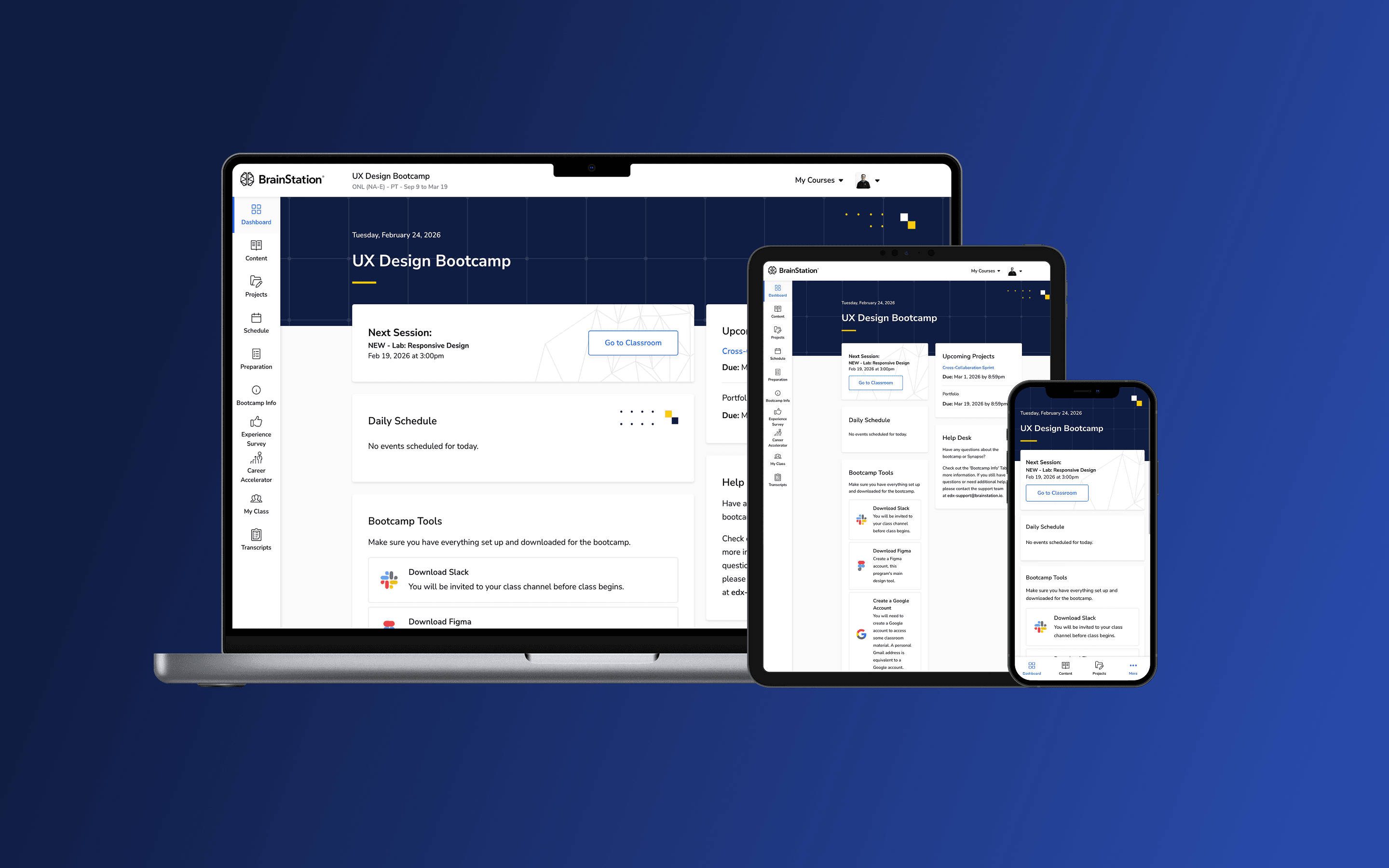
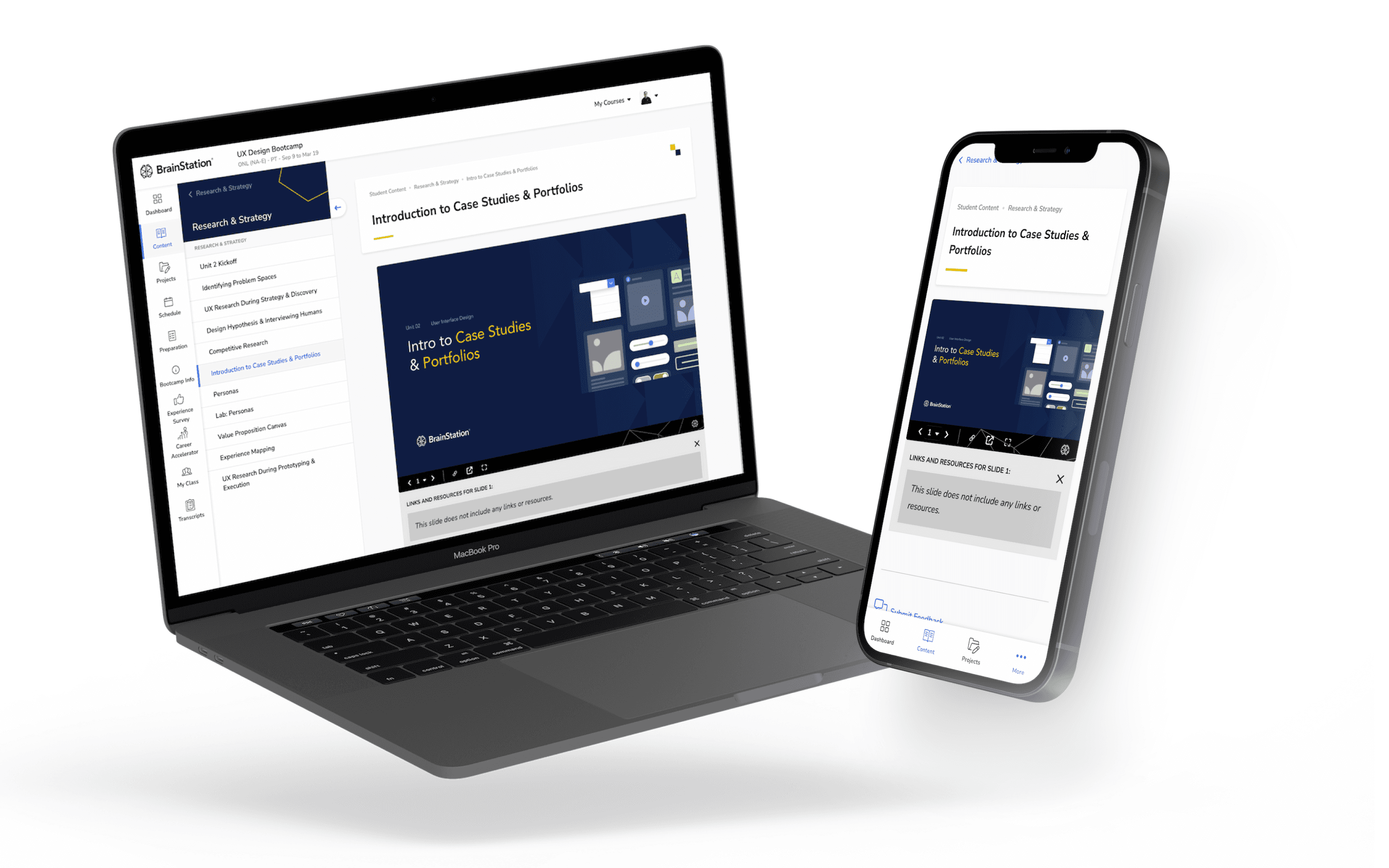
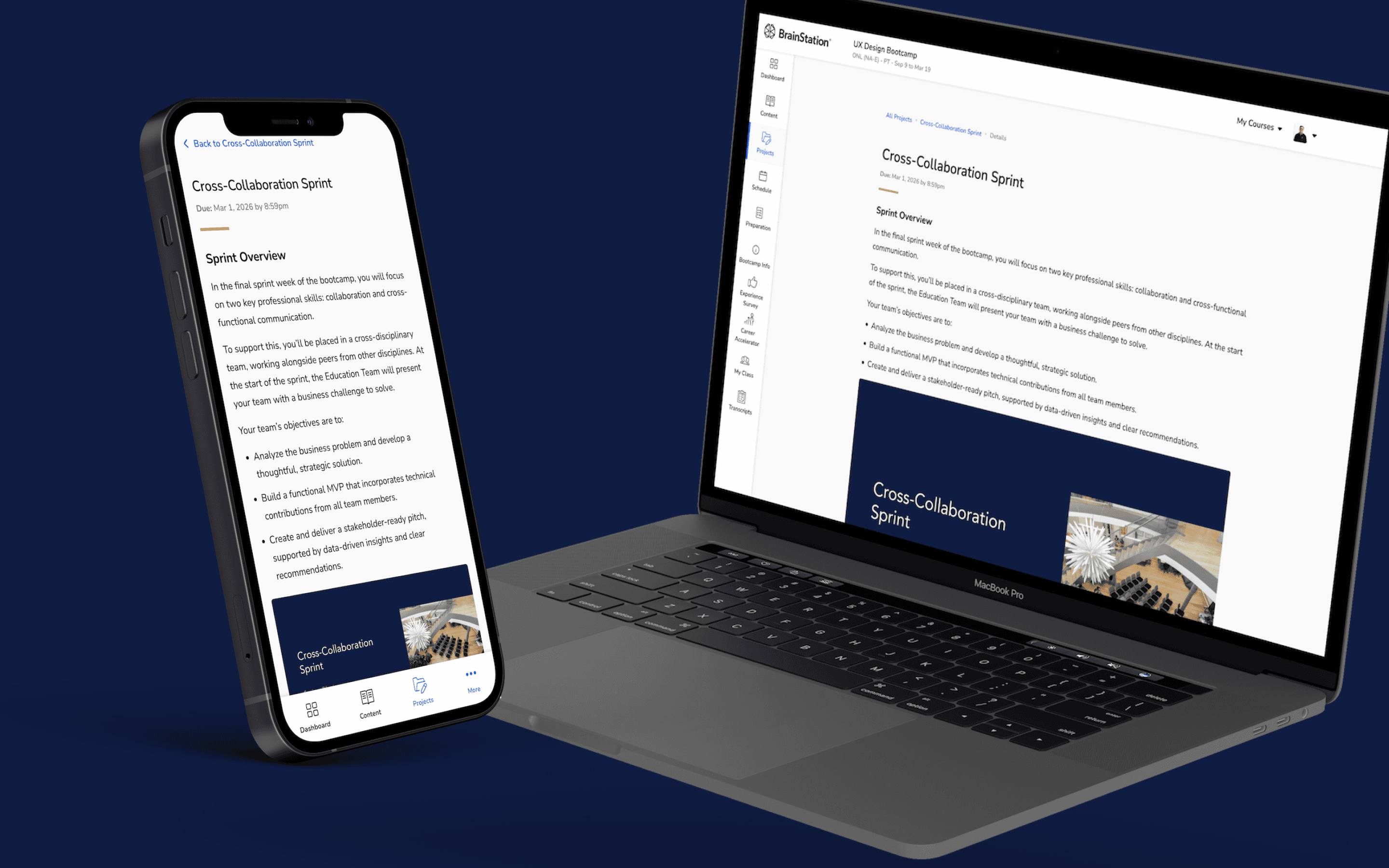
Synapse, BrainStation's learning management system. I led end-to-end design of the platform, delivering consistent curriculum across desktop, tablet, and mobile.

BrainStation Toronto campus, a renovated heritage building and the program’s first home.

The lecture view, where curriculum, educators, and platform met. Students moved through structured modules of content delivered live, with materials remaining accessible after each session.

BrainStation Toronto campus, a renovated heritage building and the program’s first home.

The project detail view, where students managed their portfolio work throughout each cohort. Synapse held progress, instructor feedback, and submissions in one structured surface.

BrainStation Toronto campus, a renovated heritage building and the program’s first home.

Cortex, the back office

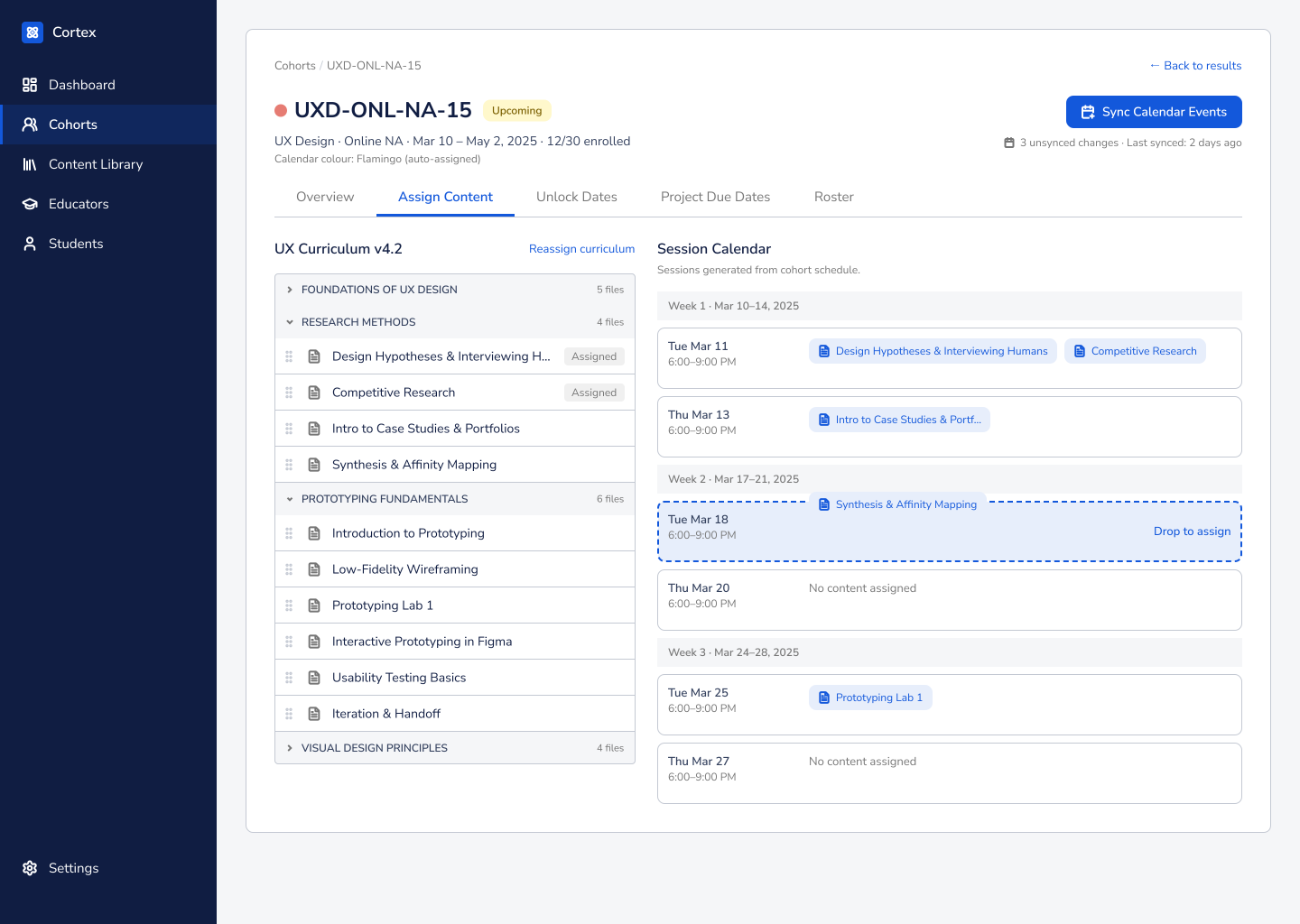
Synapse had a back office. Cortex was our custom CMS, where staff created cohort instances, generated their calendars, and mapped curriculum content onto individual sessions by drag and drop, then set unlock dates and project due dates against the same schedule. One curriculum, dozens of live instances across formats and time zones: Cortex was where that mapping happened, and Synapse was where students experienced the result.

Synapse had a back office. Cortex was our custom CMS, where staff created cohort instances, generated their calendars, and mapped curriculum content onto individual sessions by drag and drop, then set unlock dates and project due dates against the same schedule. One curriculum, dozens of live instances across formats and time zones: Cortex was where that mapping happened, and Synapse was where students experienced the result.

Cortex's cohort instance view: curriculum on the left, the generated session calendar on the right, content assigned by drag and drop. View rebuilt for portfolio; Cortex is internal to BrainStation.

BrainStation Toronto campus, a renovated heritage building and the program’s first home.

Impact

Synapse began with two flagship bootcamps, Web Development and UX Design, then scaled to power BrainStation’s entire learning portfolio.

Synapse began with two flagship bootcamps, Web Development and UX Design, then scaled to power BrainStation’s entire learning portfolio.

50K+

Professionals Impacted

Multi-year cost avoidance

Compared to licensing alternatives

4.6/5

Rating on Course Report

Global Delivery

Bootcamps, courses, workshops and events

Synapse Reimagined

Synapse Reimagined

Synapse shipped in a pre-AI world. The navigation architecture we fought over, nested or decoupled, existed to answer two questions: where am I, and what’s next? Rebuilding it today, I’d stop asking the nav rail to carry all of that.

I prototyped the concept in Figma Make: a restructured navigation plus an integrated AI learning assistant that answers where am I and what’s next directly, in context, so structure serves orientation instead of straining to simulate it.

A student asks the assistant where they are; it answers with their place in the program and what's next. Speculative concept, built in Figma Make, not affiliated with BrainStation's current product.

A student asks the assistant where they are; it answers with their place in the program and what's next. Speculative concept, built in Figma Make, not affiliated with BrainStation's current product.

Product Design, Strategy, & Leadership
Vancouver, BC

Product Design, Strategy, & Leadership
Vancouver, BC